In a nutshell
- 📈 The rise of acoustic pods and focus booths is reshaping UK offices, driven by hybrid work, speed of deployment, and improved tech (ventilation, sensors, sound attenuation).
- 💷 Clear cost-benefit: single pods (~£3k–£7k) and team pods (~£8k–£20k) boost space efficiency and punctuality; one London fintech saw a 23% drop in meeting overruns, strengthening the ROI case.
- 🔐 Governance gaps: promises of privacy clash with occupancy analytics and glass visibility; organisations need explicit surveillance transparency, data controls, and placement/fire certification policies.
- 🧩 People-first design: effective ventilation, adjustable lighting, and ergonomics are vital; inclusive accessibility features support wheelchair users and neurodivergent staff, enhancing wellbeing instead of creating “prop” spaces.
- 🌱 Beyond the trend: scrutinise sustainability via EPDs, repairability, and take-back schemes; a circular, modular strategy prevents waste and keeps pods as a dynamic, low-carbon “kit of parts.”
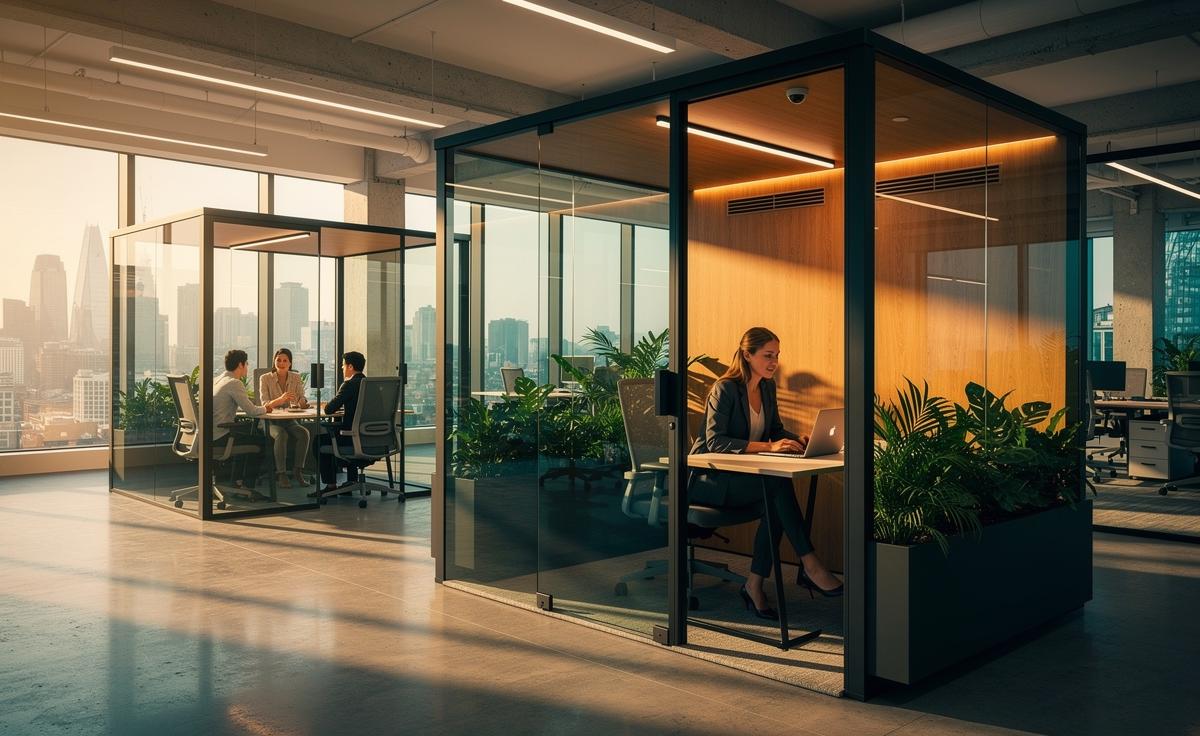
Across the UK, a new fixture is quietly remaking the modern workplace. Call them acoustic pods, focus booths, or simply office “phone boxes”: modular, sound-dampened rooms are popping up from Shoreditch startups to corporate towers in Canary Wharf. Human resource leads whisper about reduced burnout. Facilities managers talk square-foot efficiency. The property market, with its surplus of open-plan floors, has found a quick retrofit solution. The office is being rebuilt around focus. In this investigative report, we track the money, the ergonomics, and the governance risks behind the trend that’s taking over office spaces by storm—and ask whether it’s a fix, or a fashionable stopgap, for a deeper crisis in how we work.
What Is Driving the Office Pod Boom?
The rise of hybrid work left many offices with a peculiar problem: too noisy for calls, too empty for culture. Pods appear to solve both. Employees can jump into a booth for a client presentation. Teams can huddle in a small, enclosed space without booking a full meeting room. For landlords, pods are fast to install and don’t trigger the delays of traditional fit-outs. Speed and flexibility have become the new currency in workplace design. In interviews with workplace strategists, a pattern emerges: open-plan layouts are being retrofitted, not ripped out, and pods are the surgical intervention of choice.
Yet the story is not just convenience. Post-pandemic, staff are returning on days they know they can get work done, not just to be seen. Pods help rebuild confidence in the office as a productive destination. A developer in Manchester told me adoption soared when leadership tied pods to “focus hours,” nudging teams to plan deep work on site. The tech behind them—active ventilation, motion sensors, and sound attenuation—has also improved dramatically, reducing stale air complaints and echo. Culture, technology, and space are converging in a modular form factor.
Counting the Costs and Returns
Pods are not cheap. A single-person booth runs into the low thousands; spacious meeting pods cost much more. But in cities with eye-watering rents, the maths can favour modular over masonry. Capex is upfront, but ROI arrives as utilisation and productivity. Facilities teams track whether pods are booked, how long they’re used, and what they displace—unused banks of hot-desks, for instance. In several UK firms we surveyed, pods replaced a portion of fixed desks, freeing floor space for collaboration zones without expanding the lease.
| Item | Typical Range (UK) | Notes |
|---|---|---|
| Single-person pod cost | £3,000–£7,000 | Varies by acoustic rating, ventilation quality |
| Two-to-four person pod | £8,000–£20,000 | Higher fit-out spec, integrated AV |
| Average footprint | 1.2–4.5 m² | Compact compared with meeting rooms |
| Adoption rate (pilot to scale) | 3–12 months | Often staged across floors |
Where do savings arise? Reduced noise complaints, fewer double-booked rooms, and higher effective capacity. A London fintech reported a 23% fall in meeting overruns once small pods were introduced for one-to-one calls. Space efficiency is the headline, but the subtext is time: meetings start on time when there’s somewhere to go. Still, buyers should scrutinise warranties, fire certifications, and maintenance. The cheapest booth can become the most expensive if it fails quietly on air quality.
Privacy, Surveillance, and Policy Gaps
Pods promise privacy, but do they deliver it? Acoustically, many models suppress intelligibility but not volume—colleagues might not hear the words, yet they sense a heated call. Visual privacy is a second faultline: glass panels look sleek, but they expose body language. Then there’s data. Some pods ship with occupancy sensors or “smart” analytics, sometimes feeding building management systems. HR leaders increasingly ask what is collected, who can see it, and for how long. Transparency is a trust issue, not a technical feature. Without clear signage and policies, smart pods can feel like a trap rather than a tool.
Accessibility is another oversight. Are controls reachable from a seated position? Is the door threshold navigable for wheelchair users? Does lighting cause glare for neurodivergent staff? The best pods support adjustable lighting and clear ventilation controls, not buried touch panels. From a compliance perspective, procurement teams should examine fire egress ratings and the classification of pods under local regulations. A facilities manager in Birmingham recounted a costly delay when a shipment lacked the right documentation for placement near stairwells. Good governance travels with the pod—from purchase to placement to policy.
Design, Wellbeing, and Environmental Impact
Pods are also a wellbeing story. Reduced noise levels correlate with lower cognitive load; better focus reduces after-hours catch-up work. But the wellbeing dividend depends on design. Ventilation must be active and quiet. Lighting should be warm and adjustable, not interrogation-bright. Ergonomics matter: a sleek stool looks great until the third hour of spreadsheet triage. If a pod isn’t comfortable, it becomes a prop, not a practice. Designers increasingly specify biophilic cues—timber veneers, plant shelves, natural textures—to soften the box-in-a-box experience and signal calm rather than confinement.
The environmental question is complicated. Pods can avoid demolition waste by removing the need for built walls, and many manufacturers tout recycled materials and modular reusability. On the other hand, cheap units with limited lifespan risk becoming tomorrow’s landfill. Buyers should ask for Environmental Product Declarations, repairability options, and take-back schemes. A circular strategy—leasing pods, remanufacturing panels, swapping modules—keeps embodied carbon in play. The most forward-looking workplaces treat pods as part of a dynamic, low-waste kit of parts, reconfiguring as teams ebb and flow. Sustainability is designed into the procurement brief, not discovered at the end.
As the pod phenomenon spreads from creative studios to law firms and local councils, the big question is whether it can rewrite office culture or merely patch its rough edges. There’s real progress: fewer noise complaints, more respectful calls, more choices for how to work. Yet risks persist when policy lags product, or when shiny booths mask deeper issues of workload and autonomy. The smart move is intentional adoption: clear rules, inclusive design, and honest measurement of outcomes. If your office is next, what will you ask of a pod—beyond its promise of silence—to make it truly work for everyone?
Did you like it?4.6/5 (24)